Curved stairlifts are one of the most common things people ask us about, and for good reason. If your home has a staircase that bends, turns, or has a landing partway up, the question of which type of stairlift you need becomes a pretty important one before you spend any money. The short answer: the shape of your staircase determines the type of stairlift you need, and choosing wrong means the lift simply won’t fit. Here’s a practical look at how the two compare, what to expect from each, and how we can help you figure out the right fit for your home.
What Makes a Staircase “Curved” in the First Place
A straight staircase runs in one uninterrupted line from bottom to top, no turns, no landings, no curves. If that describes your stairs, a straight stairlift is typically a straightforward solution, and it tends to be less expensive and quicker to install because the rail comes in standard sizes that can be trimmed to fit.
A curved staircase is anything that doesn’t fit that description. That includes staircases with a single turn or bend, L-shaped stairs with a landing in the middle, spiral or helical staircases, and stairs that gradually arc from one floor to the next. Even a small intermediate landing can disqualify a straight rail from working properly. This is where a curved stairlift becomes the right answer rather than just an option.
How Curved Stairlifts Are Built Differently
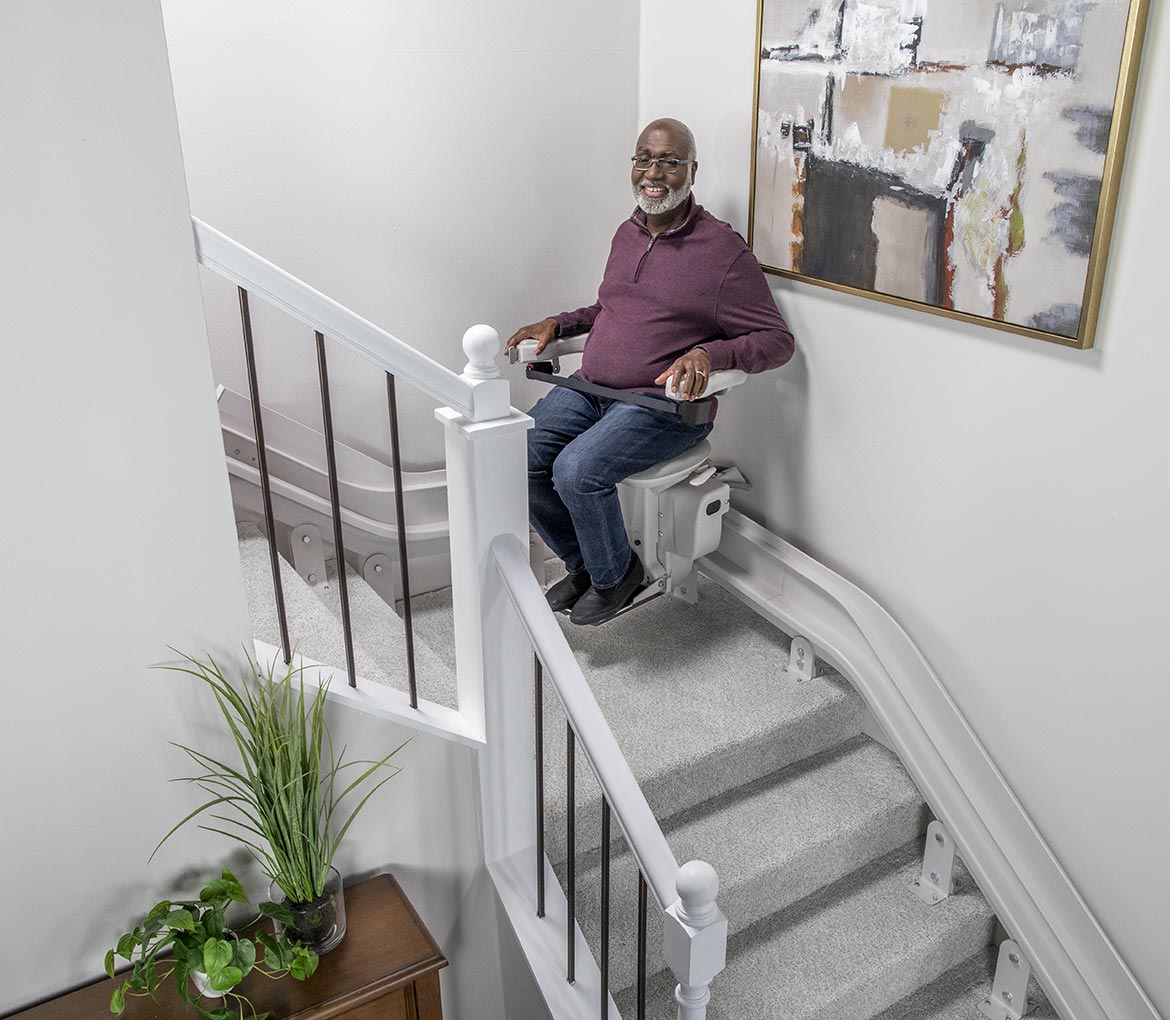
Unlike straight lifts, curved stairlifts use a custom-fabricated rail that is bent and shaped specifically for your staircase. Every home is a little different, so the rail for a curved lift is typically measured and manufactured to match your exact configuration. That precision is what makes them work so reliably, and it’s also why they cost more and take longer to produce than straight models.
Brands like Bruno, which we carry here at Access Mobility Products, have built strong reputations for curved stairlift engineering. The rail hugs the contour of the staircase closely, which matters both for safety and for keeping the footprint of the lift as compact as possible. For families in La Crosse, WI, Sparta, WI, and Onalaska, WI who live in older homes with non-standard stair configurations, a custom curved rail is often the only practical solution.
Cost and Timeline: Setting Realistic Expectations
We want to be upfront with people about this. A curved stairlift will generally cost more than a straight one, sometimes considerably more, because of the custom manufacturing involved. The timeline from measurement to installation is also longer, since the rail has to be fabricated after we take detailed measurements of your specific staircase.
A straight stairlift, by contrast, can often be installed within days of your order. If your stairs qualify, it’s a faster and more budget-friendly path. For customers in Rochester, MN, Winona, MN, and surrounding areas who are working within a tighter timeline or budget, knowing this distinction up front helps everyone plan better.
Which One Do You Actually Need
The honest answer is that you need a professional to look at your stairs. We’ve been doing this for over 35 years, and we’ve seen every variation imaginable, from century-old farmhouse staircases in western Wisconsin to newer construction with tricky split-level layouts across southeastern Minnesota. What looks like a “mostly straight” staircase to a homeowner sometimes has a subtle curve or winder steps that make a straight rail impossible.
When we come out for an assessment, we measure the staircase carefully, note every turn, step width, and landing, and talk with you about how the lift will be used day to day. That conversation matters. Someone who transfers from a wheelchair has different needs than someone who simply has trouble with balance on the stairs, and we factor all of that in.
We also talk through practical details like where the lift will park at the top and bottom, how it will affect other family members walking past on the stairs, and whether any doorways or hallways near the staircase will be impacted by the rail overhang. These are the kinds of things that make a real difference once you’re living with the equipment every day.
A Few Things Worth Knowing Before You Call
If you’re trying to do a little homework before reaching out, here’s what’s useful to note about your staircase: whether it goes straight from floor to floor or has any turns, landings, or curves; the approximate number of steps; and whether the stairs are indoors or outdoors. Outside stairlift installations are also something we handle, and they have their own set of considerations around weatherproofing and rail material.
You don’t need to have all the answers before you contact us. That’s what the assessment is for. We serve customers throughout La Crosse, WI, Sparta, WI, Onalaska, WI, Rochester, MN, Winona, MN, and the surrounding areas, and our team is happy to come take a look and give you an honest recommendation with no pressure.
If you have questions about curved stairlifts, straight stairlifts, or any other mobility solution for your home or vehicle, please give us a call or drop us an email. We’re always glad to help you think it through.